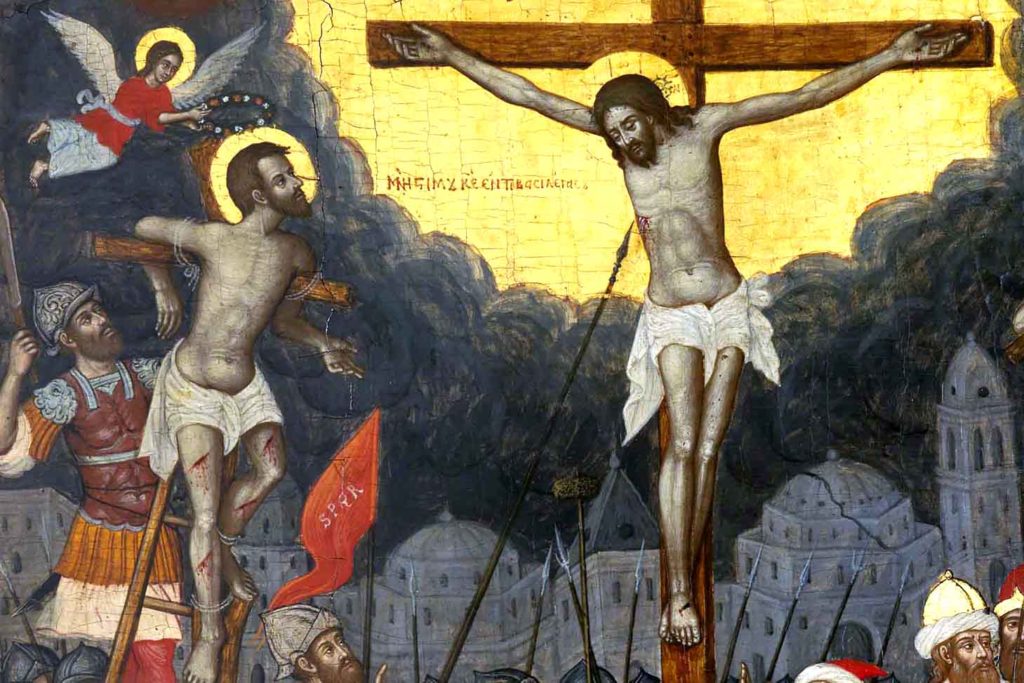
A common objection that gets raised by those looking in at the Christian faith from the outside is with regards to the doctrines on Heaven and Hell. Why do we say Hitler could have been saved by just saying sorry before killing himself? Why do we say seemingly “good” people might go to hell? Isn’t an eternal existence in Hell unjust, no matter the severity of the crimes that was committed here on Earth? Surely God knows my heart, and will reward me because I am a good person! Before I can address these objections, let’s clarify what exactly we mean by Heaven, Hell, and repentance.
On Heaven and Hell
Unfortunately, popular conceptions of what Heaven and Hell are like have been overwhelmingly influenced by popular media, and especially by Dante’s Divine Comedy (Inferno, Purgatorio, and Paradiso). I cannot stress enough how Dante’s writings, to my best estimation, are best described as 14th century Italian Catholic fan-fiction. So, let’s try to relearn what Heaven and Hell really are.
Let’s start with Heaven. First of all, Heaven is not the final destination for those who are saved. It could be described as a kind of holding place while the world waits for the final resurrection and judgment. The final destination is actually a new physical creation entirely, a perfect union of Heaven and Earth akin to something like a marriage at a cosmic level between God and humanity.
Isaiah 65:17 (ESV)
17 “For behold, I create new heavens
and a new earth,
and the former things shall not be remembered
or come into mind.“
Mark 13:31 (ESV)
31 Heaven and earth will pass away, but my words will not pass away.
Romans 8:19-22 (ESV)
19 For the creation waits with eager longing for the revealing of the sons of God. 20 For the creation was subjected to futility, not willingly, but because of him who subjected it, in hope 21 that the creation itself will be set free from its bondage to corruption and obtain the freedom of the glory of the children of God. 22 For we know that the whole creation has been groaning together in the pains of childbirth until now.
2 Peter 3:13 (ESV)
13 But according to his promise we are waiting for new heavens and a new earth in which righteousness dwells.
Revelation 21:1-4 (ESV)
1Then I saw a new heaven and a new earth, for the first heaven and the first earth had passed away, and the sea was no more. 2 And I saw the holy city, new Jerusalem, coming down out of heaven from God, prepared as a bride adorned for her husband. 3 And I heard a loud voice from the throne saying, “Behold, the dwelling place of God is with man. He will dwell with them, and they will be his people, and God himself will be with them as their God. 4 He will wipe away every tear from their eyes, and death shall be no more, neither shall there be mourning, nor crying, nor pain anymore, for the former things have passed away.”
Now Heaven is rarely a sticking point for people who are inquiring about Christianity. You will seldom hear, if ever, any complaints along the lines of “Heaven doesn’t sound good enough for me!” We all I think intuitively understand that Heaven is minimally a place we all want to go to, hence the commonly negative reaction one has when they are told they might not make it there in the end.
Hell, however, is a separate beast of its own. Responsible for religious fear, distortions of God’s character, and outright rejection of the entire “Heaven and Hell system”, Hell can often be labeled as Christianity’s “most hated doctrine”.
I cannot do a proper treatment on the doctrines of Hell, with their varied forms, in this article. It deserves a dedicated article where I can get into the nuances of how different Christian thinkers have come to understand Hell, as well as where I currently land and why. For this article, I will simply establish a very modest claim: Hell is a place you do not want to go.
For a brief Biblical witness, I will simply point to the words of Jesus since we can agree he would know more about it than anyone else.
Matthew 10:28 (ESV)
28 And do not fear those who kill the body but cannot kill the soul. Rather fear him who can destroy both soul and body in hell.
Mark 9:43-48 (ESV)
43 And if your hand causes you to sin, cut it off. It is better for you to enter life crippled than with two hands to go to hell, to the unquenchable fire. 45 And if your foot causes you to sin, cut it off. It is better for you to enter life lame than with two feet to be thrown into hell. 47 And if your eye causes you to sin, tear it out. It is better for you to enter the kingdom of God with one eye than with two eyes to be thrown into hell, 48 ‘where their worm does not die and the fire is not quenched.’
Matthew 13:37-42 (ESV)1
37 He answered, “The one who sows the good seed is the Son of Man2. 38 The field is the world, and the good seed is the sons of the kingdom. The weeds are the sons of the evil one, 39 and the enemy who sowed them is the devil. The harvest is the end of the age, and the reapers are angels. 40 Just as the weeds are gathered and burned with fire, so will it be at the end of the age. 41 The Son of Man will send his angels, and they will gather out of his kingdom all causes of sin and all law-breakers, 42 and throw them into the fiery furnace. In that place there will be weeping and gnashing of teeth.
I know it is popular these days to joke along the lines of “I’ll happily go to hell! All of the fun people will be there and we can have our own party!” I don’t know about you, but a place that guarantees an experience of “weeping and gnashing of teeth” is not quite the party I want to be a part of.3
With a (very) simple visual of the two “destinations” that await all people now illustrated, let us dive into the specifics of what affects our individual destinations.
On Repentance
First, let’s establish that the Bible teaches that repentance is a necessary step in salvation. It is often juxtaposed with a lack of repentance leading to death.
2 Peter 3:9 (ESV)
9 The Lord is not slow to fulfill his promise as some count slowness, but is patient toward you, not wishing that any should perish, but that all should reach repentance.
2 Thessalonians 2:10 (ESV)
10 and with all wicked deception for those who are perishing, because they refused to love the truth and so be saved.
So, what is repentance exactly? Is it just simply saying sorry? Certainly not! That would lead to the above passage in 2 Peter reading quite strangely:
…not wishing that any should perish, but that all should reach [apologizing].
The original Greek sheds light on the weightier meaning of the word “repentance” that the New Testament authors intended, and that is metanoia4. Metanoia carries with it a deeper meaning of “changing one’s mind”. It can be validly understood as undergoing a complete reversal of one’s life and perspectives, genuinely denouncing their past sins, and a commitment to doing better in the future. Let’s reread 2 Peter 3:9 with that definition in mind and see if it fits better.
…not wishing that any should perish, but that all should reach [a thorough change of the mind].
That seems to fit much better now. So we should move forward with this understanding that genuine repentance requires much more than a couple of words, but requires a changing of one’s own heart, a plead for mercy from God (see Luke 18:9-14), and a commitment to turn their life around from this point on. I hope this at minimum puts to bed any ideas that one can “trick” God into letting them into Heaven without having to actually change their behavior here on Earth as if getting into Heaven was a task of pressing the right buttons on a machine.
Who Needs to Repent?
Everyone, everywhere, from all time needs repentance and mercy. First, I’ll let the apostles Paul and John lay out the Biblical understanding of everyone’s position when it comes to sin:
Romans 3:11-20 (ESV)
11 “None is righteous, no, not one;
no one understands;
no one seeks for God.
12 All have turned aside; together they have become worthless;
no one does good,
not even one.”
13 “Their throat is an open grave;
they use their tongues to deceive.”
“The venom of asps is under their lips.”
14 “Their mouth is full of curses and bitterness.”
15 “Their feet are swift to shed blood;
16 in their paths are ruin and misery,
17 and the way of peace they have not known.”
18 “There is no fear of God before their eyes.”
19 Now we know that whatever the law says it speaks to those who are under the law, so that every mouth may be stopped, and the whole world may be held accountable to God. 20 For by works of the law no human being will be justified in his sight, since through the law comes knowledge of sin.
1 John 1:5-10 (ESV)
5 This is the message we have heard from him and proclaim to you, that God is light, and in him is no darkness at all. 6 If we say we have fellowship with him while we walk in darkness, we lie and do not practice the truth. 7 But if we walk in the light, as he is in the light, we have fellowship with one another, and the blood of Jesus his Son cleanses us from all sin. 8 If we say we have no sin, we deceive ourselves, and the truth is not in us. 9 If we confess our sins, he is faithful and just to forgive us our sins and to cleanse us from all unrighteousness. 10 If we say we have not sinned, we make him a liar, and his word is not in us.
I could quote many more passages but this article is getting long already. Just know that the Biblical witness is abundantly clear: “…all have sinned and fall short of the glory of God…” (Romans 3:23 ESV).
You may be tempted at this point to start attempting to justify your own life. You are probably having thoughts along the lines of: “I give homeless people food when I see them!” or “I donate to charity” or “I’m really not that bad of a person!” Doing good is of course a good thing, no one is arguing against that. But any complaints you may have must ultimately stem from an unjustified assumption: God owes me Heaven as my just wages for the good works I perform/the bad works I refrain from performing. Where does such an assumption come from? Where is the contract for such an agreement, with yours and God’s signatures on it? It bears repeating that “going to Heaven” is not simply a reward of paradise to hard workers, but rather full communion with God. So it would be wise to pay attention when God himself clarifies the conditions for such communion, as opposed to leaning on made-up assumptions.
I stand firm with the Biblical witness, we all have done evil. And not just evil, but evil knowingly and willingly. If you think such a claim does not apply to you, try thinking of all of the bad things in your life. Such a thought experiment can be scary, because you will realize just how much you have suppressed.
As a final point, I want to ward against the opposite extreme of what be called “worm theology”. This thinking sets human nature as so evil that there are zero redeeming qualities remaining. Such a worldview I believe fails to account for the genuinely good things that non-Christians accomplish everyday. My contention is that Heaven is a place for perfection, and attempting to arrive there as anything less than perfect is an impossibility that no one can overcome… by their own strength. I tell you that our situation is not hopeless…
Romans 7:21-25 (ESV)
21 So I find it to be a law that when I want to do right, evil lies close at hand. 22 For I delight in the law of God, in my inner being, 23 but I see in my members another law waging war against the law of my mind and making me captive to the law of sin that dwells in my members. 24 Wretched man that I am! Who will deliver me from this body of death? 25 Thanks be to God through Jesus Christ our Lord!
Does Repentance “Earn” My Salvation
One final clarification that needs to be made at this point is this: our repentance does not mean we now “deserve” to go to Heaven. Repentance alone does not save us, but rather the life, death, and resurrection of Jesus Christ is what saves us. Full repentance entails cleaving oneself to a simple reality, Jesus died so that I may live. The exact mechanism of how that works out is not so simple a task to figure out. One might argue that there is no exact mechanism in such a profound act as God dying as a man5.
Now that we have our foundation set, we can finally walk through the typical boundary cases of “salvation/damnation” with some clearer principles to apply.
An Evil Person Repents On Their Deathbed
Let’s return to the Hitler deathbed confession scenario. Based on this definition of repentance, in theory yes even Hitler could have been saved. I am forced to look upon the famous thief on the cross.
Luke 23:39-43 (ESV)
39 One of the criminals who were hanged railed at him, saying, “Are you not the Christ? Save yourself and us!” 40 But the other rebuked him, saying, “Do you not fear God, since you are under the same sentence of condemnation? 41 And we indeed justly, for we are receiving the due reward of our deeds; but this man has done nothing wrong.” 42 And he said, “Jesus, remember me when you come into your kingdom.” 43 And he said to him, “Truly, I say to you, today you will be with me in paradise.”
However, we don’t necessarily have to guess at what ultimately happened to Hitler. We know that in the end, he chose to take his own life rather than face human justice. I will claim that this is not the action of a repentant man, but rather of a man who fully recognized his evil in the end and thought he could escape from the just penalty of his actions. And I will support my claim by using a person from the Bible with a similar ending: Judas.
Matthew 27:5 (ESV)
3 Then when Judas, his betrayer, saw that Jesus was condemned, he changed his mind and brought back the thirty pieces of silver to the chief priests and the elders, 4 saying, “I have sinned by betraying innocent blood.” They said, “What is that to us? See to it yourself.” 5 And throwing down the pieces of silver into the temple, he departed, and he went and hanged himself.
“But Gabriel, he sounds repentant here!” He certainly seemed sorry, but this was ultimately not repentance as far as we understand it. True repentance would not lead someone to suicide, but rather would lead someone to seek out restoration. It fails the final aspect of repentance: commitment to do better in the future. This point might make more sense by seeing Judas’ parallel: the betrayal of Jesus by Peter.6
Mark 14:66-72 (ESV)
66 And as Peter was below in the courtyard, one of the servant girls of the high priest came, 67 and seeing Peter warming himself, she looked at him and said, “You also were with the Nazarene, Jesus.” 68 But he denied it, saying, “I neither know nor understand what you mean.” And he went out into the gateway and the rooster crowed. 69 And the servant girl saw him and began again to say to the bystanders, “This man is one of them.” 70 But again he denied it. And after a little while the bystanders again said to Peter, “Certainly you are one of them, for you are a Galilean.” 71 But he began to invoke a curse on himself and to swear, “I do not know this man of whom you speak.” 72 And immediately the rooster crowed a second time. And Peter remembered how Jesus had said to him, “Before the rooster crows twice, you will deny me three times.” And he broke down and wept.
As of this point in the story of Jesus, Peter is actually in exactly the same position as Judas. Both ultimately betray the teacher they claimed to love, but the betrayals are different of course. Judas hands him over directly to the Jewish authorities. Peter simply denies association with him. But is that denial so simple? He does it 3 times in a row, after Jesus predicted he would do exactly that only a few hours earlier!7 Worse than that, he does it for free. At least Judas was paid. So then, why do Christians typically see Judas as evil and Peter as righteous? This is a great question, and it strikes at the heart of the topic of discussion today. It simply comes down to this: how these two men reacted when they realized what horrible acts they had committed differed dramatically. Where Judas succumbed to his despair and took his own life, Peter instead found mercy through repentance.
John 21:15-17 (ESV)
15 When they had finished breakfast, Jesus said to Simon Peter, “Simon, son of John, do you love me more than these?” He said to him, “Yes, Lord; you know that I love you.” He said to him, “Feed my lambs.” 16 He said to him a second time, “Simon, son of John, do you love me?” He said to him, “Yes, Lord; you know that I love you.” He said to him, “Tend my sheep.” 17 He said to him the third time, “Simon, son of John, do you love me?” Peter was grieved because he said to him the third time, “Do you love me?” and he said to him, “Lord, you know everything; you know that I love you.” Jesus said to him, “Feed my sheep.”
Does the threefold questioning ring a bell? It should! Here, Jesus is directly bringing to mind Peter’s threefold betrayal. Does he do this to torture Peter with guilt? Does this show that we have to repent specifically for every sin we ever commit? The answer to both is no (though we strive to be continually repentant). Rather, Jesus is showing in a way that was clear to Peter (see v. 17) without openly declaring it (and therefore publicly shaming Peter) that he has forgiven those moments of betrayal.
To summarize this scenario: yes an incredibly evil person could repent on their deathbed and be saved. However, this is incredibly unlikely and you can trust that God’s justice does not allow for cheap loopholes.
A Good Person is Not a Christian
This case has already been somewhat addressed with the end of the On Repentance section. This objection hinges on an unspoken assumption, namely that God owes salvation to the one who does good works. I will simply repeat my two basic responses to such an objection. One, such an assumption is simply unjustified. Two, even “good” people have a skeleton or two in their closet. Heaven entails full communion with God, a perfect being by definition who would violate his nature if he brought imperfect creatures to him. No one is perfect, and therefore everyone falls short of the requirement of perfection. The difference between the “morally grey” position of the good Christian and the good non-Christian is this: the Christian through their repentance asks to be separated from their evil. The non-Christian through their lack of repentance chooses to hold onto their evil and therefore suffers the punishment that their evil deserved. God’s justice should ultimately serve as a source of reassurance. Evil will not ultimately escape justice, and that should be cause for celebration.
Someone Dies Without Hearing About Jesus
Someone is born into a remote village somewhere where the Gospel has not been preached. They go their whole lives without hearing it and eventually die. What happens to them? This situation requires a few different angles of approach, but let us start with one agreement: their ultimate verdict will be just either way. God will not judge people for being ignorant beyond their control.
Luke 12:47-48 (ESV)
47 And that servant who knew his master’s will but did not get ready or act according to his will, will receive a severe beating. 48 But the one who did not know, and did what deserved a beating, will receive a light beating.
Romans 3:23-25 (ESV)
23 for all have sinned and fall short of the glory of God, 24 and are justified by his grace as a gift, through the redemption that is in Christ Jesus, 25 whom God put forward as a propitiation by his blood, to be received by faith. This was to show God’s righteousness, because in his divine forbearance he had passed over former sins.
However, I will still claim that those who die without knowledge of Jesus are not necessarily getting a free pass. As Paul states:
Romans 2:14-16 (ESV)
14 For when Gentiles, who do not have the law, by nature do what the law requires, they are a law to themselves, even though they do not have the law. 15 They show that the work of the law is written on their hearts, while their conscience also bears witness, and their conflicting thoughts accuse or even excuse them 16 on that day when, according to my gospel, God judges the secrets of men by Christ Jesus.
This is partly why there is such an importance of evangelism for Christians. We want to avoid anyone dying without the knowledge of Jesus! I recognize this situation is still not quite answered at this point. Ultimately, it is beyond my position to say what exactly happens to individuals in this position. What I can confidently say is that I know their final verdict will be just, and I will lean on the revealed character of God as one who loves humanity infinitely more than we can imagine for such a claim.
A Bad Person is a Christian
What about someone who claims to be a Christian but genuinely does horrible things? Unfortunately it is all too easy to think of examples here. A man goes to Church on Sunday, but then for the next 6 days he lives like a drunk, beats his wife and kids, etc. A priest, abusing his sacred role within the church, molests children. A slave owner cherry-picks Bible verses without proper context to justify their wicked practices. I need not go on.
Such blatant hypocrisy will not go unanswered. If there was a survey of Christians where they were asked what passage from the Bible scares them the most, I imagine these very words of Jesus Christ would be number one by a large margin.
Matthew 7:21-23 (ESV)8
21 “Not everyone who says to me, ‘Lord, Lord,’ will enter the kingdom of heaven, but the one who does the will of my Father who is in heaven. 22 On that day many will say to me, ‘Lord, Lord, did we not prophesy in your name, and cast out demons in your name, and do many mighty works in your name?’ 23 And then will I declare to them, ‘I never knew you; depart from me, you workers of lawlessness.’
I believe this verse is sufficient answer to the current “salvation/damnation” scenario. However, I want to provide further clarification.
First off, do not take this to mean that only outwardly-righteous individuals will be saved. The thief on the cross would fail that test, but Jesus himself verbally guaranteed his salvation. Christianity proper does not suppose itself to be a community of morally perfect individuals. Rather, one of the most common images of the Church is that of a hospital full of sick people. The ultimate goal is to be healed, but if a hospital only had healthy individuals, one would wonder where exactly the hospital was!
Secondly, do not make the mistake of overcorrection by believing that you will be safer by avoiding church and organized religion altogether. If Christianity is simply all about “me and Jesus”, how will you be held accountable when you inevitably go astray? There is also of course the serious threat of Satan, who “prowls around like a roaring lion, seeking someone to devour”9. To think that one could resist such a threat on their own is foolish, and ultimately prideful. If the Church was superfluous, Jesus wouldn’t have established such a church.
Matthew 16:13-19 (ESV)
13 Now when Jesus came into the district of Caesarea Philippi, he asked his disciples, “Who do people say that the Son of Man is?” 14 And they said, “Some say John the Baptist, others say Elijah, and others Jeremiah or one of the prophets.” 15 He said to them, “But who do you say that I am?” 16 Simon Peter replied, “You are the Christ, the Son of the living God.” 17 And Jesus answered him, “Blessed are you, Simon Bar-Jonah! For flesh and blood has not revealed this to you, but my Father who is in heaven. 18 And I tell you, you are Peter, and on this rock I will build my church, and the gates of hell shall not prevail against it. 19 I will give you the keys of the kingdom of heaven, and whatever you bind on earth shall be bound in heaven, and whatever you loose on earth shall be loosed in heaven.”
Therefore let us make sure we find ourselves within a church body, not only for our own benefit, and not only because we might be called to be a help to others, but ultimately because such an institution was created by Jesus Christ himself.
Concluding Thoughts
This article sought out to help clarify the Christian position on Heaven, Hell, and who receives justice/mercy from God. I have kept “cognitively functioning adults” as the primary subject of our varied cases. I recognize that there are a very large number of people who would not fall within this category, such as those who have severe mental disabilities, infants, and young children. In the interest of getting this article completed, I will cover that topic in a future (and hopefully shorter) post.
If I could summarize the right mentality when it comes to who we should anticipate to find in (and out) of Heaven in a single phrase, it would be this: expect quite a few surprises.
- Read Matthew 13:24-36 for fuller context. ↩︎
- This is Jesus’ most used label for himself. ↩︎
- As a side note, Jesus speaks too much about Hell as something he personally will facilitate for him to be accurately seen as simply a “teacher of good morals”. Such a good teacher wouldn’t dare equate themselves as the ultimate judge at the end of time. ↩︎
- https://www.blueletterbible.org/lexicon/g3341/esv/mgnt/0-1/ ↩︎
- See this article for a “first attempt” treatment of how the death of Christ works for our salvation. ↩︎
- For a fuller context of what is happening here, start at Mark 14:43. ↩︎
- See Mark 14:29-31. ↩︎
- Personally, I believe a goal of sorts is to live a life in such a way that this verse does not invoke fear for you are so assured of your right relation with God that you can be confident you are avoiding such a grievous error. ↩︎
- 1 Peter 5:8 ↩︎
 Gabriel Gardner Blog