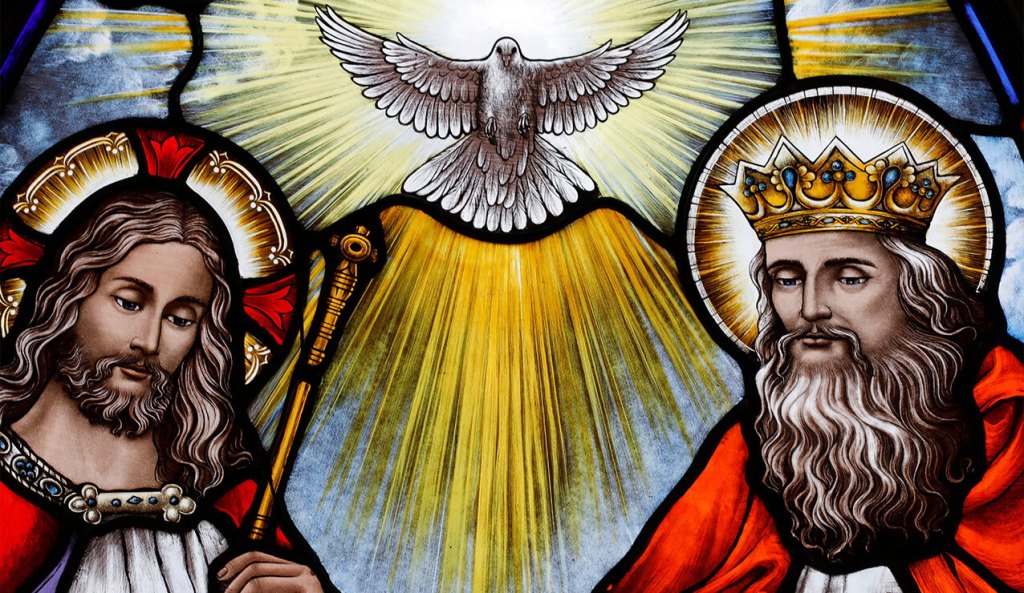
Christianity claims to be a monotheistic religion, but then we go ahead and complicate things by saying God is a trinity. Isn’t that three separate gods? Short answer, no. Thanks for reading, I’ll see you in the next post…
Ok jokes aside, this can be a very difficult subject to understand because it is attempting to describe the very nature of God. If it were easy to understand, we should be hesitant to believe we had arrived at an accurate understanding of God. As I build up the motivation behind the establishment of trinitarian doctrine, just know for now that the Trinity is a claim that God is one in essence/nature (what God is), but three in person (who God is).
The Old Testament Teaches the Trinity
Now Christians will be accused of “inventing” the Trinity. If one only takes 30 seconds to investigate the claim, then sure we invented it. The word “trinity” is nowhere to be found in the Bible in all its entirety in any translation. But this fails to address the complexity of the situation Christians found themselves in. The early Christians, with the Tanakh (Old Testament) and the burgeoning New Testament writings were given all of the building blocks necessary to enter into a deeper understanding of God. Let’s look at a few of these passages, and hopefully it will become clear that a unipersonal (only one who) identifier for God simply fails to account for the entire biblical corpus. I will put [YAHWEH] in place of any “the LORD” occurrences to make it more explicit, see this footnote for more1.
Genesis 1:1-2 (ESV)
1In the beginning, God created the heavens and the earth. 2 The earth was without form and void, and darkness was over the face of the deep. And the Spirit of God was hovering over the face of the waters.
Why the switch from God to “Spirit of God” (also validly translated as “breath of God”)? This appears to show the Holy Spirit participating in creation.
Genesis 1:26 (ESV)
26 Then God said, “Let us make man in our image, after our likeness.
Now there is certainly some debate over this passage, but what I don’t believe is debatable is that a plural is used here. Typically the debate goes something like “God is referring to his angels”, or perhaps a pantheon of gods akin to the likes of Greek mythology. The second objection, that God is referring to other gods, doesn’t work simply because it is not consistent with other passages where God is clear that he alone is God. See Isaiah 44:6-8 for an especially clear passage. Maybe the other objection is correct? But then you would have to conclude that either God’s angels are godlike, or God is angelic (our image, our likeness), which just ultimately falls back into the second objection either way.
Genesis 19:24 (ESV)
24 Then [YAHWEH] rained on Sodom and Gomorrah sulfur and fire from [YAHWEH] out of heaven.
If God is unipersonal, why imply that God on the Earth is calling sulfur and fire from God in heaven? It would have been more straight forward to say:
Then [YAHWEH] rained on Sodom and Gomorrah sulfur and fire from heaven.
But of course that is not what the text says.
Deuteronomy 6:4 (ESV)
4 “Hear, O Israel: [YAHWEH] our God, [YAHWEH] is one.
Here, Yahweh is labeled as “one”. Doesn’t this serve to disprove the idea of a trinity? Well let’s look closer. The word used here in Hebrew is echad. Echad is typically used to invoke a complex unity and by no means necessarily means “singular”2. Yachid, which more stronly invokes a singularity or “oneness”, would have been a more natural word choice to use for God if he was unipersonal. We don’t even have to go to a word dictionary however to at least get a clue that something more complex is going on, because echad is used earlier in Genesis.
Genesis 2:24 (ESV)
24 Therefore a man shall leave his father and his mother and hold fast to his wife, and they shall become one [echad] flesh.
Now there is a danger to overstate the case, and then therefore imply that God is actually a pantheon of gods the same way Adam and Eve (two separate beings) makeup one flesh. This should simply raise to your attention that God using echad to describe both Adam and Eve’s relationship and his own nature certainly means that God’s true reality is likely more complicated than just a singular personhood.
2 Samuel 23:2-3 (ESV)
2 “The Spirit of [YAHWEH] speaks by me;
his word is on my tongue.
3 The God of Israel has spoken;
the Rock of Israel has said to me:
Here we have King David referring to the “Spirit of [YAHWEH]”, and then continuing on as if this same subject is the God of Israel.
Psalm 110 (ESV)
1 [YAHWEH] says to my Lord:
“Sit at my right hand,
until I make your enemies your footstool.”
2 [YAHWEH] sends forth from Zion
your mighty scepter.
Rule in the midst of your enemies!
3 Your people will offer themselves freely
on the day of your power,
in holy garments;
from the womb of the morning,
the dew of your youth will be yours.
4 [YAHWEH] has sworn
and will not change his mind,
“You are a priest forever
after the order of Melchizedek.”
5 The Lord is at your right hand;
he will shatter kings on the day of his wrath.
6 He will execute judgment among the nations,
filling them with corpses;
he will shatter chiefs[d]
over the wide earth.
7 He will drink from the brook by the way;
therefore he will lift up his head.
This is a psalm aka prayer of King David. Here we see Yahweh talking to some other figure called “the Lord” (Hebrew adoni). This cannot be about David himself due to how this psalm begins. David is clearly recounting a conversation between God and some other adoni. Now adoni is typically used for human rulers (as opposed to adonai which is used for God for explicitly), and so people will say Christians misinterpret this psalm and mistakenly believe it teaches the trinity when it doesn’t. But keep reading. This supposedly “mere human” will be a priest forever and will judge the nations “on the day of his [adoni’s] wrath”. These are quite lofty prerogatives for someone who is ultimately just a human.
Malachi 3:1-2 (ESV)
1 “Behold, I send my messenger, and he will prepare the way before me. And the Lord whom you seek will suddenly come to his temple; and the messenger of the covenant in whom you delight, behold, he is coming, says [YAHWEH] of hosts. 2 But who can endure the day of his coming, and who can stand when he appears? For he is like a refiner’s fire and like fullers’ soap.
Malachi 3 is very interesting. First Yahweh says he is sending a messenger to prepare the way for him (Yahweh), but then switches to talking about some other person (the Lord or adoni). This Lord will come to his temple (not Yahweh’s temple apparently), and is also labeled the messenger of the covenant. But I thought Yahweh gave the covenant? Who is this messenger figure3?
The New Testament (and Jesus) Teaches the Trinity
What I have shown so far is by no means exhaustive (this post is already much longer than I had anticipated), but hopefully you are seeing this mysterious interplay going on with Yahweh, Yahweh’s spirit, and this adoni/messenger figure. Let’s see how the New Testament brings further clarity to the subject, but one last note before we enter the New Testament. Understand that the New Testament authors regularly use “God” to refer to the person of the Father. They will also often interchangeably use different senses of the word “God”. The context will typically draw out what sense of the word is most appropriate.
John 1:1-3; 14 (ESV)
1 In the beginning was the Word, and the Word was with God, and the Word was God. 2 He was in the beginning with God. 3 All things were made through him, and without him was not any thing made that was made.
14 And the Word became flesh and dwelt among us, and we have seen his glory, glory as of the only Son from the Father, full of grace and truth.
Here the Word (aka Jesus) was God in the beginning, but was also with God (the Father) in the beginning. A clear unity in “what-ness” (both are God) but a distinction in “who-ness” (the Son and the Father).
Matthew 28:19 (ESV)
19 Go therefore and make disciples of all nations, baptizing them in the name of the Father and of the Son and of the Holy Spirit
Here Jesus teaches us the Trinity by showing that the persons of the Father, Son, and Holy Spirit all deserve equal representation in the making of new disciples under God.
Philippians 2:5-11 (ESV)
5 Have this mind among yourselves, which is yours in Christ Jesus, 6 who, though he was in the form of God, did not count equality with God a thing to be grasped, 7 but emptied himself, by taking the form of a servant, being born in the likeness of men. 8 And being found in human form, he humbled himself by becoming obedient to the point of death, even death on a cross. 9 Therefore God has highly exalted him and bestowed on him the name that is above every name, 10 so that at the name of Jesus every knee should bow, in heaven and on earth and under the earth, 11 and every tongue confess that Jesus Christ is Lord, to the glory of God the Father.
Here Paul describes both Jesus willing to give up his authoritative role as God for the sake of embracing humility, but then through this humility re-earning his right to receive praise and worship all at the behest of God the Father. This is quite a strange thing for the Father to do for he also says:
Isaiah 42:8 (ESV)
8 I am [YAHWEH]; that is my name;
my glory I give to no other,
nor my praise to carved idols.
Unless of course this is another type of occurrence we found in Genesis 19:24, and here Yahweh shares his glory with Yahweh. The book of Hebrews actually reinforces this idea:
Hebrews 1:8-12 (ESV)
8 But of the Son he says,
“Your throne, O God, is forever and ever,
the scepter of uprightness is the scepter of your kingdom.
9 You have loved righteousness and hated wickedness;
therefore God, your God, has anointed you
with the oil of gladness beyond your companions.”
10 And,
“You, Lord, laid the foundation of the earth in the beginning,
and the heavens are the work of your hands;
11 they will perish, but you remain;
they will all wear out like a garment,
12 like a robe you will roll them up,
like a garment they will be changed.[a]
But you are the same,
and your years will have no end.”
Here we have God the Father stating in no unclear terms that the Son is also God, that he made all of creation, and that he is the same and has no end of days.
Get On With It Already!
Ok, I hope at this point I have sufficiently motivated the problem. The Bible, both New and Old Testament alike, have this “clear mystery” about the nature and personhood of God. There is too much to simply ignore, so how do we explain it all? Through the doctrine of the Trinity.
So the Trinity can essentially be described the way I have already introduced it: God is one “what” but three “who’s”. The image below is helpful.
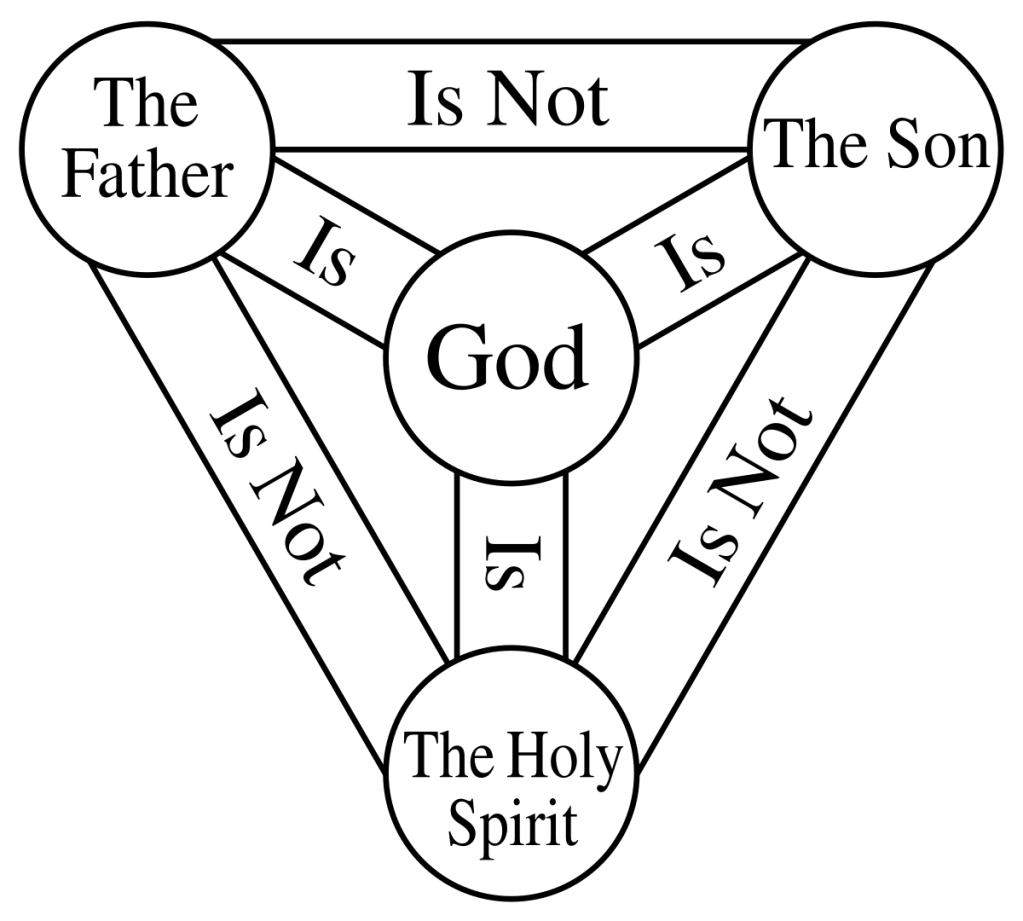
Is this a possible definition of God, or is it self-contradictory? Let’s investigate drawing out a distinction between being and person. Start with a rock. We would both agree that rock is a being (a “rock being” so to speak), but it definitely doesn’t have a person or personal identity attached to it. If we progress upwards to a human, a human is a “human being” but also has a personal identity attached to it. For example I am a human being but my personhood acts through this being called Gabriel. So therefore Gabriel can act upon the world, whereas a rock is simply passive. This hopefully showcases how being and person are not forced to have a one-to-one correspondence.
Well then, if we are talking about God, should we expect him to be easily found reflected by creation, or should he be categorically above his creation? Some people really argue the former4, but I hope you will agree that the latter is a fair assumption. I actually love how strange the Trinity really is (it should be strange, and if it doesn’t seem strange you probably haven’t thought about it deeply enough), because it kind of shows how it is probably not something that a bunch of old grey men came up with.
I actually intentionally titled this blog post the way I did, because the conclusion should be that God is not like any thing in the world. In fact, the opening image of this post is misleading. The Father is not embodied in any sense at all, so to depict him like an older man is wrong. The same goes for the Holy Spirit, so while the dove is a nice callback to the baptism of Jesus it should not be taken as a literal depiction. Only through Jesus, who is “… the radiance of the glory of God and the exact imprint of his nature…” (Hebrews 1:3), do we get a proper visual representation of God. And only Jesus and the Holy Spirit, by nature of both being God, have properly beheld the Father. So God, as the Trinity, is spirit (and therefore not physical). Only the Son has taken on an “imagistic” physical form to bring a visual representation, while the Father and the Holy Spirit remain in a spiritual form.
One Possible Variant
What I shared above is what would be defined as a “Western Christian” understanding of the Trinity. Now I would be remiss to lead you to believe this is the only way to think of the Trinity. The Orthodox Christian tradition (which is another branch akin to Catholicism or Protestantism) has a slightly varied take on the Trinity (there is a LOT of overlap, thus why I don’t see the two views in any major disagreement). I don’t claim to understand it in its entirety but I will share what I understand about it. The following image is a helpful visual.
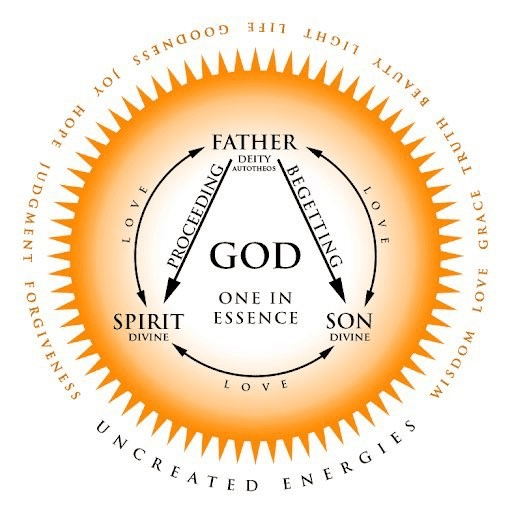
The Orthodox Trinity I believe is probably a more accurate take on the Trinity (again, I am not an expert and could definitely do more research here). The Western churches at least claim a distinction in the persons of the Trinity, but don’t quite flesh out what that looks like exactly. In Orthodoxy, the persons are distinct, and that is shown through their unique relations to each other. The Father serves as the fonte or the source. The Son is just that because he is begotten by the Father from all eternity (not to be confused with a biological birthing or a spiritual creation). The Holy Spirit proceeds from the Father from all eternity and is sent by the Son from all eternity. There has never been a time where God consisted of just the Father, but the three have had their relations with each other from all eternity. Their connection to each other is at an intimate level nowhere near comparable to God’s overall relation to his creatures (the Western Trinity can claim this statement as well). Now the Orthodox have an even deeper teaching on the “essence/energy distinction” that I believe is meant to explain how God can so closely interact with creation (this is a problem eastern religions struggle with too, to the best of my knowledge), but that is beyond the scope of what I want to do here, and I also have no idea how to appropriately represent it so I won’t bother risking misrepresentation of that doctrine.
A Potentially Helpful (and Potentially Heretical) Analogy
Trying to do analogies for the Trinity is always dangerous, because analogies almost by definition try pointing to something in the world to help explain a concept. To do that for God, who is by definition not of this world, is to likely do God a disservice. Church history is littered with heresies born out of potentially well-intentioned but ultimately mistaken analogies.
That being said, here is an analogy I like. I want to make extra clear that this analogy is simply to try to relate the different roles the persons of the Trinity take in relation to creation. This analogy is not to help understand the actual nature of the Trinity. This analogy is also probably closer to the Orthodox Trinity than it is to the Western Trinity.
Let’s think of God like the Sun. The Father is the nuclear processes that go on in the core. This is not immediately accessible to us and would likely destroy us to see this process up close. But how do we know the Sun is there? Through two primary means: light and warmth. The light gives us the most direct means of obtaining intellectual understanding of what the Sun is, and is a direct consequence of the “nuclear processes of the Father”. And so the Son (Jesus) is the light that shows us the radiance of the Father. But the Sun also provides warmth. This Holy Spirit warmth originates from the same nuclear processes of the Father, but is carried to the Earth by means of the light (aka the Holy Spirit sent by the Son but proceeding from the Father). This warmth is how we come to feel the Sun. Together, they provide us with the fullest possible understanding of the Sun.
Try explaining the Sun to someone who lived in a pitch-black cave their whole life. If you stop at just the nuclear reactions, the person has no idea what the sun is like. It would essentially just be math at this point. If you add just the light, the person can easily mistake it for a big flashlight. Add just the warmth, and you have an oversized heater. Only together can you give the clearest picture, and only then can this cave-person understand the clarity of day that the Sun provides, and the comfort of warmth it grants to everyone who basks in the light. Now the cave-person can understand more clearly what it is like to live on the surface.
Love Demands a Trinity
A fascinating conclusion that comes out of the Trinity is the realization that only the Trinity can account for a God who is not just loving, but is in his very nature love itself. With one person, you can demonstrate self-love, easy enough. With two persons, you can demonstrate love for another. With three persons, you can demonstrate shared love for another (akin to two parents who together share in loving their child). Any more people beyond three is redundant and provides no further concepts of unique and intimate love. And so all of these versions of love are possible through the Trinity and can be assumed to be part of God’s very nature. The Trinity is loving with or without us.
How can a unipersonal God claim to be inherently loving of anything other than himself while also claiming that this God is not dependent on creation? I suppose I understand why other religions throughout history (both monotheistic and polytheistic) posit that God or the gods don’t love their creation nor are they interested in it. Because why should they? Nothing in their nature demands it of them.
If we believe that love is real, then naturally we should seek to know an account of whence it came. I believe only something like the Trinity provides a satisfactory answer, and only the Bible teaches the Trinity.
1 John 4:15-17 (ESV)
15 Whoever confesses that Jesus is the Son of God, God abides in him, and he in God. 16 So we have come to know and to believe the love that God has for us. God is love, and whoever abides in love abides in God, and God abides in him. 17 By this is love perfected with us, so that we may have confidence for the day of judgment, because as he is so also are we in this world.
- In the Old Testament, you will see occurrences of “the LORD” (the “ORD” will be in small capital letters). This is in place of the original Hebrew name for God “Yahweh”, which literally is derived from the Hebrew verb “to be”. Thus “Yahweh” (or the consonant only version “YHWH”) is often translated as “I am”. This is why it is such a big deal when Jesus says “before Abraham was, I am” (John 8:58). He is clearly taking possession of the one true name of God. ↩︎
- Read this article from chabad.org for more on a Jewish understanding of God’s “oneness”. ↩︎
- This would detract from the main point of this post, but I will more fully address the idea that Jesus (before he took on human flesh) was active in the Old Testament in a different post. ↩︎
- I ran into a cult at UC Riverside (called World Mission Society, Church of God or “WMSCOG” for short) and they believe that because there are male and female creatures, there must be two gods, one male and one female. ↩︎
 Gabriel Gardner Blog
One response to “What in the World is the Trinity?”
[…] benefit from a better understanding of orthodox Christian understandings of the Trinity (see this post for more on the Trinity), but I will continue on to respond regardless. As an extra credit […]
LikeLike